


How to Size a Commercial BESS for a Factory: A Complete Selection Guide
Factories often consume large amounts of electricity, especially during production hours when heavy machinery, motors, compressors, HVAC systems, and other industrial equipment operate simultaneously. As electricity costs rise and energy management becomes increasingly important, more manufacturers are considering commercial battery energy storage systems (BESS) to improve energy efficiency, reduce peak demand, and support renewable energy integration.
However, choosing the right battery storage capacity is not as simple as matching a battery to a factory's monthly electricity consumption.
A properly sized commercial BESS for a factory must consider several factors, including peak power demand, daily electricity consumption, load profiles, operating hours, required backup duration, solar PV capacity, and the factory's energy management strategy.
This guide explains how to calculate the required BESS power and energy capacity, evaluate different operating scenarios, and select a suitable industrial battery storage solution.
A commercial battery energy storage system can help factories manage electricity consumption more efficiently. However, an undersized or oversized system may not deliver the expected economic or operational benefits.
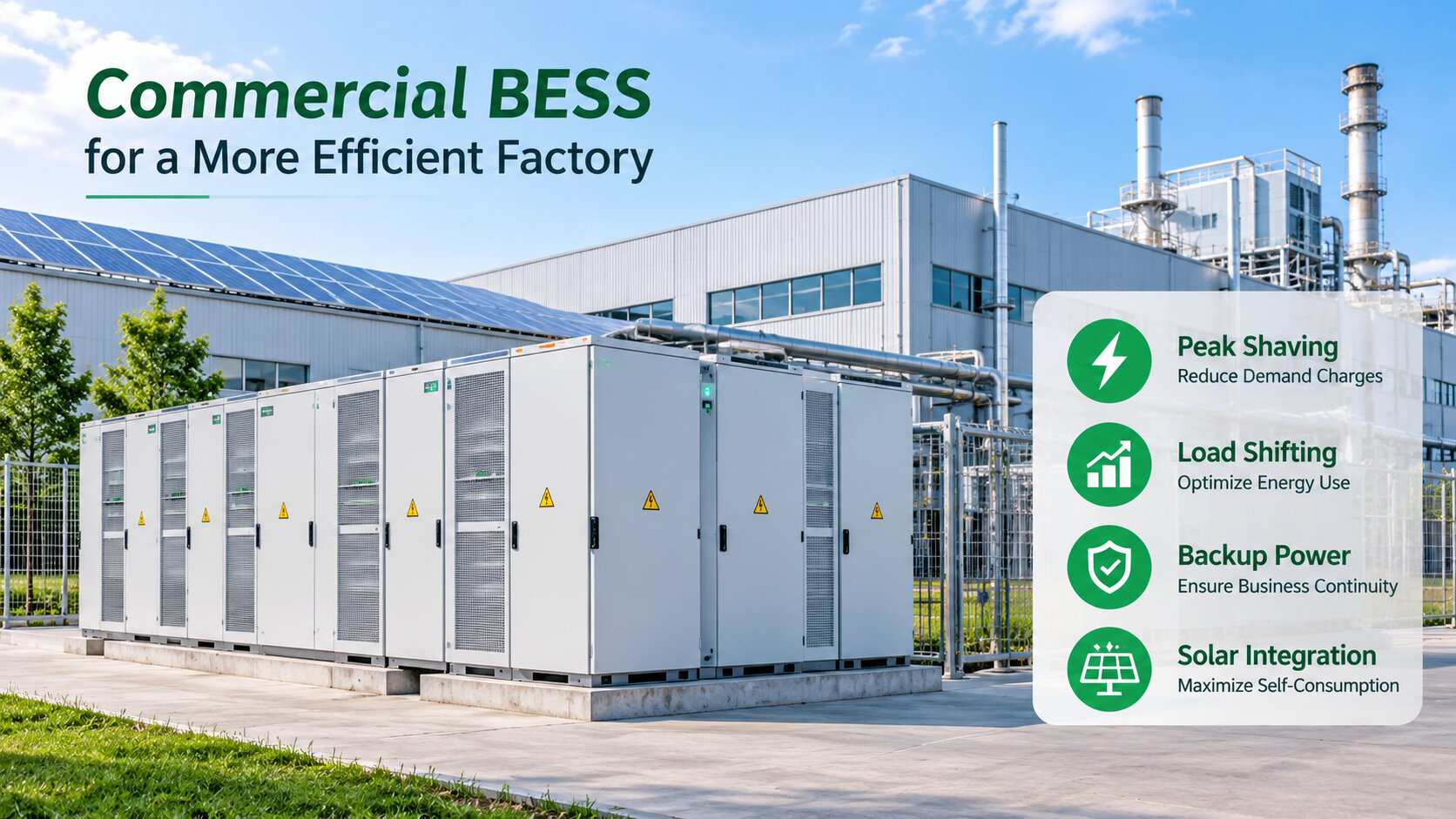
A properly designed factory BESS can support several applications.
Many industrial facilities experience high electricity demand during certain production periods. Depending on the local electricity tariff, peak demand may contribute significantly to monthly electricity bills.
A battery energy storage system can discharge during high-demand periods to reduce the amount of electricity drawn from the grid.
Factories may charge batteries during periods of lower electricity prices and discharge them during more expensive periods.
This strategy can help businesses optimize electricity costs when time-of-use tariffs are available and the price difference justifies the investment.
Some manufacturing processes require continuous power to protect equipment, maintain production conditions, or prevent data loss.
A properly configured BESS with suitable backup and islanding capabilities can supply designated critical loads during grid interruptions.
Not every grid-connected BESS automatically provides backup power. The PCS, electrical architecture, protection devices, and control system must support the required operating mode.
Factories with rooftop solar installations may generate more electricity than they can immediately consume during certain periods.
A battery storage system can store surplus solar energy and release it later when factory electricity demand increases or solar generation decreases.
This can improve on-site solar energy utilization.
Before calculating battery capacity, it is essential to understand the difference between power and energy.
These two specifications determine whether a BESS can meet a factory's electricity requirements.
Power capacity indicates how much electricity a battery system can deliver or absorb at a given moment.
For example:
50 kW BESS: Can deliver up to 50 kW of power, subject to its operating limits.
100 kW BESS: Can deliver up to 100 kW of power.
200 kW BESS: Can deliver up to 200 kW of power.
The required power rating depends on the factory's maximum demand, the loads that need to be supported, and the intended operating strategy.
Energy capacity indicates how much electrical energy a battery can store.
For example:
100 kWh: Stores 100 kilowatt-hours of energy.
215 kWh: Stores 215 kilowatt-hours of energy.
261 kWh: Stores 261 kilowatt-hours of energy.
Energy capacity determines how long the battery can supply a particular load.
A simplified relationship is:
Discharge Duration = Available Battery Energy (kWh) ÷ Discharge Power (kW)
For example, a battery system with 200 kWh of usable energy supplying a constant 100 kW load could theoretically operate for approximately 2 hours.
Actual operating time depends on conversion losses, operating limits, temperature, battery condition, and the system's control strategy.
For a more detailed explanation, see our guide to commercial BESS power and energy.
Related Articles:commercial BESS power and energy.
Accurate load data is the foundation of commercial BESS sizing.
Before selecting a battery storage system, factory owners or project engineers should collect the following information.
Electricity bills can provide an initial understanding of the factory's energy consumption and electricity costs.
Important information includes:
Monthly electricity consumption (kWh)
Maximum demand (kW)
Time-of-use electricity prices
Peak and off-peak tariff periods
Power factor charges, where applicable
Electricity tariff structure
These details help determine whether the primary objective should be peak shaving, load shifting, backup power, or solar self-consumption.
Monthly electricity consumption alone is not enough to determine the correct BESS size.
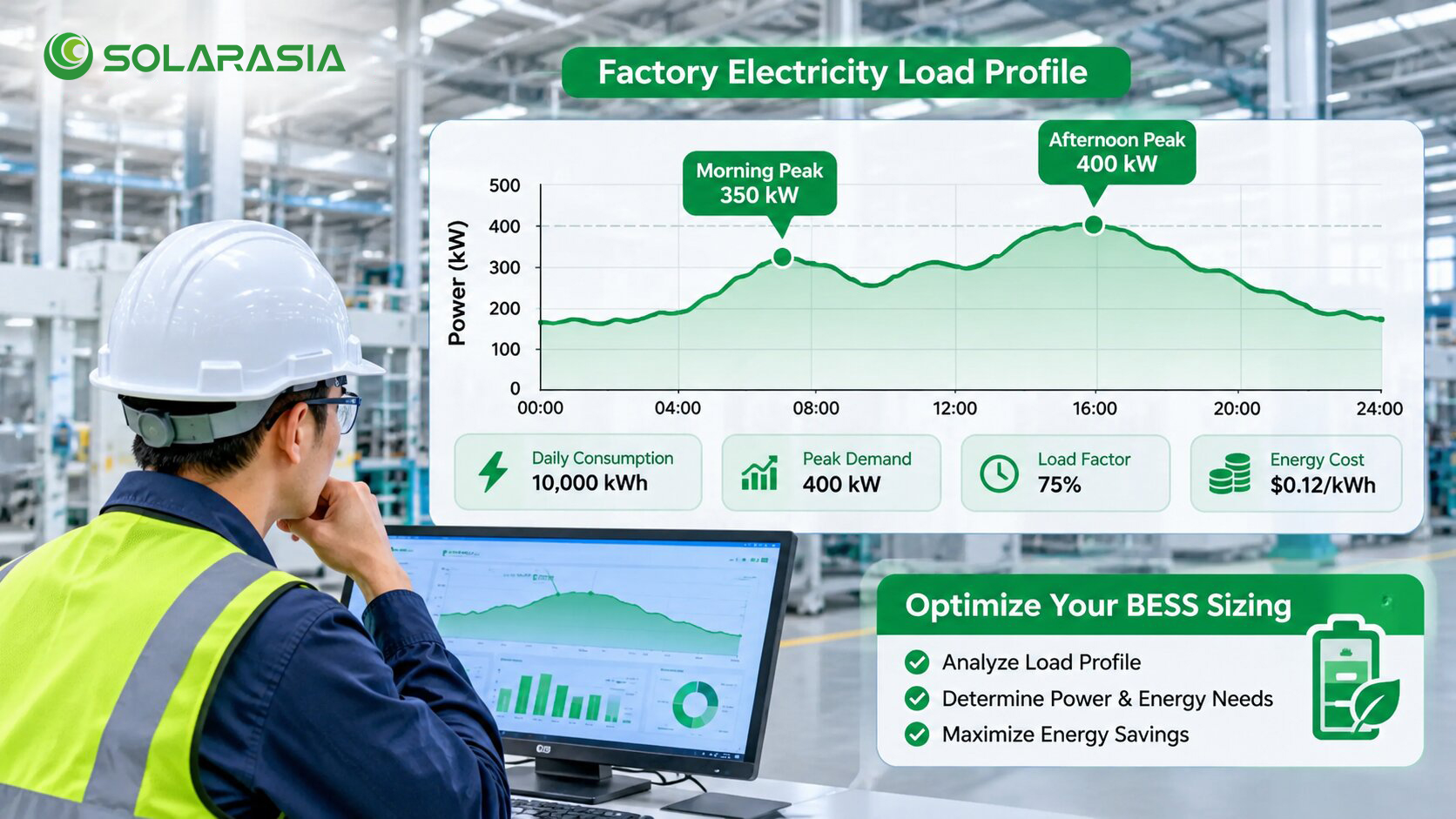
A factory may consume 10,000 kWh per day, but its electricity demand could vary significantly throughout the day.
For example:
| Time | Factory Load |
|---|---|
| 00:00–06:00 | 100 kW |
| 06:00–08:00 | 180 kW |
| 08:00–12:00 | 350 kW |
| 12:00–14:00 | 280 kW |
| 14:00–18:00 | 400 kW |
| 18:00–22:00 | 220 kW |
| 22:00–24:00 | 120 kW |
This simplified example shows that the factory experiences its highest electricity demand during the afternoon production period.
A BESS designed for peak shaving should be evaluated against the actual load profile rather than the average daily consumption.
Ideally, project designers should obtain 15-minute or 30-minute interval electricity data covering representative operating periods.
If backup power is required, identify which factory equipment must remain operational during a grid outage.
Examples include:
Production control systems
Industrial automation equipment
Refrigeration systems
Essential pumps
Communication and monitoring systems
Emergency lighting
The total critical load may be considerably lower than the factory's total installed electrical capacity.
This distinction can prevent unnecessary battery investment.
The required BESS power rating depends on the factory's intended application.
There is no single power rating that suits every industrial facility.
For a basic peak-shaving estimate, use:
Required BESS Discharge Power = Original Peak Demand − Target Grid Demand
For example:
Original factory peak demand: 500 kW
Target grid demand: 400 kW
Required peak reduction: 100 kW
The initial BESS power target would therefore be approximately 100 kW.
However, the final PCS rating should also consider load fluctuations, response requirements, operating limits, and any required charging power.
For backup applications, calculate the total demand of the loads that must remain operational.
For example:
| Critical Equipment | Power Demand |
|---|---|
| Production Control System | 20 kW |
| Refrigeration Equipment | 40 kW |
| Essential Pumps | 25 kW |
| Communication Equipment | 5 kW |
| Other Critical Loads | 10 kW |
| Total | 100 kW |
In this example, the system needs to supply approximately 100 kW of continuous critical load.
However, the PCS must also be checked for short-term overload capability, motor starting currents, power factor, and load transients.
For a factory with an existing solar PV installation, the required battery power depends on the surplus solar generation available for charging and the electricity demand during discharge periods.
For example, if the factory frequently has 150 kW of surplus solar generation, a BESS with an appropriately configured charging power could capture part of that energy.
The final rating should be based on actual solar generation and factory consumption data.
Once the required power rating has been determined, the next step is calculating the battery's energy capacity.
The calculation depends on how long the system needs to discharge.
A basic formula is:
Required Usable Energy = BESS Discharge Power × Required Discharge Duration
For example:
A factory wants to reduce grid demand by 100 kW for 3 hours.
100 kW × 3 hours = 300 kWh
The system must therefore deliver 300 kWh of usable AC energy during the discharge period.
However, the nominal battery capacity must account for the usable state-of-charge window and system efficiency.
A simplified sizing formula is:
Nominal Battery Capacity = Required AC Energy ÷ (Usable DoD × Discharge Efficiency)
Assume:
Required AC energy: 300 kWh
Usable depth of discharge: 90%
Discharge efficiency: 95%
Calculation:
300 ÷ (0.90 × 0.95) = 350.9 kWh
The initial nominal battery capacity requirement is approximately 351 kWh.
This is an illustrative calculation. Actual sizing must follow the manufacturer's definition of rated and usable capacity, conversion efficiency, operating limits, and project design requirements.
If the system must still meet the required energy output near the end of its service life, battery degradation and the required end-of-life capacity should also be considered.
Related Articles:commercial battery storage cost.
Different factories have different energy consumption patterns. Therefore, the optimal BESS configuration depends on the actual application.
A manufacturing facility may operate heavy machinery during daytime production hours.
Typical requirements include:
High discharge power
Frequent daily charging and discharging
Peak demand management
Integration with factory energy management systems
A BESS designed for this application should be evaluated using the factory's hourly or interval-based load profile.
Cold storage facilities often require continuous electricity for refrigeration and temperature control.
Their main considerations may include:
Continuous critical load requirements
Backup duration
Compressor starting characteristics
Electricity tariff differences
Temperature-sensitive operations
The battery system should be designed around the actual refrigeration load and the facility's required backup strategy.
A factory with an existing solar PV installation may use BESS to store excess solar generation.
The main considerations include:
Solar generation profile
Daytime factory consumption
Evening electricity demand
Required charging and discharging power
AC-coupled or DC-coupled architecture
The correct configuration depends on the existing inverter system, electrical design, and project requirements.
After calculating the required power and energy capacity, factory owners can compare available BESS configurations.
For example:
| BESS Configuration | Rated Power | Rated Energy | Theoretical Full-Power Duration |
|---|---|---|---|
| System A | 100 kW | 215 kWh | 2.15 hours |
| System B | 100 kW | 261 kWh | 2.61 hours |
| System C | 200 kW | 430 kWh | 2.15 hours |
| System D | 200 kW | 522 kWh | 2.61 hours |
These figures are theoretical ratios of rated energy to rated power. They do not represent guaranteed usable discharge duration.
Actual discharge duration depends on usable battery capacity, PCS efficiency, operating conditions, and manufacturer specifications.
When comparing commercial battery storage systems, factory owners should evaluate more than just the rated kWh.
Important factors include:
Battery chemistry, such as LiFePO4
Battery cell specifications
Battery management system (BMS)
Power conversion system (PCS)
Energy management system (EMS)
Cooling and thermal management
Fire detection and protection
Protection and monitoring functions
System efficiency
Warranty and technical support
The system should be evaluated as an integrated energy storage solution rather than as a battery cabinet alone.
A correctly sized BESS must also be compatible with the factory's existing electrical infrastructure.
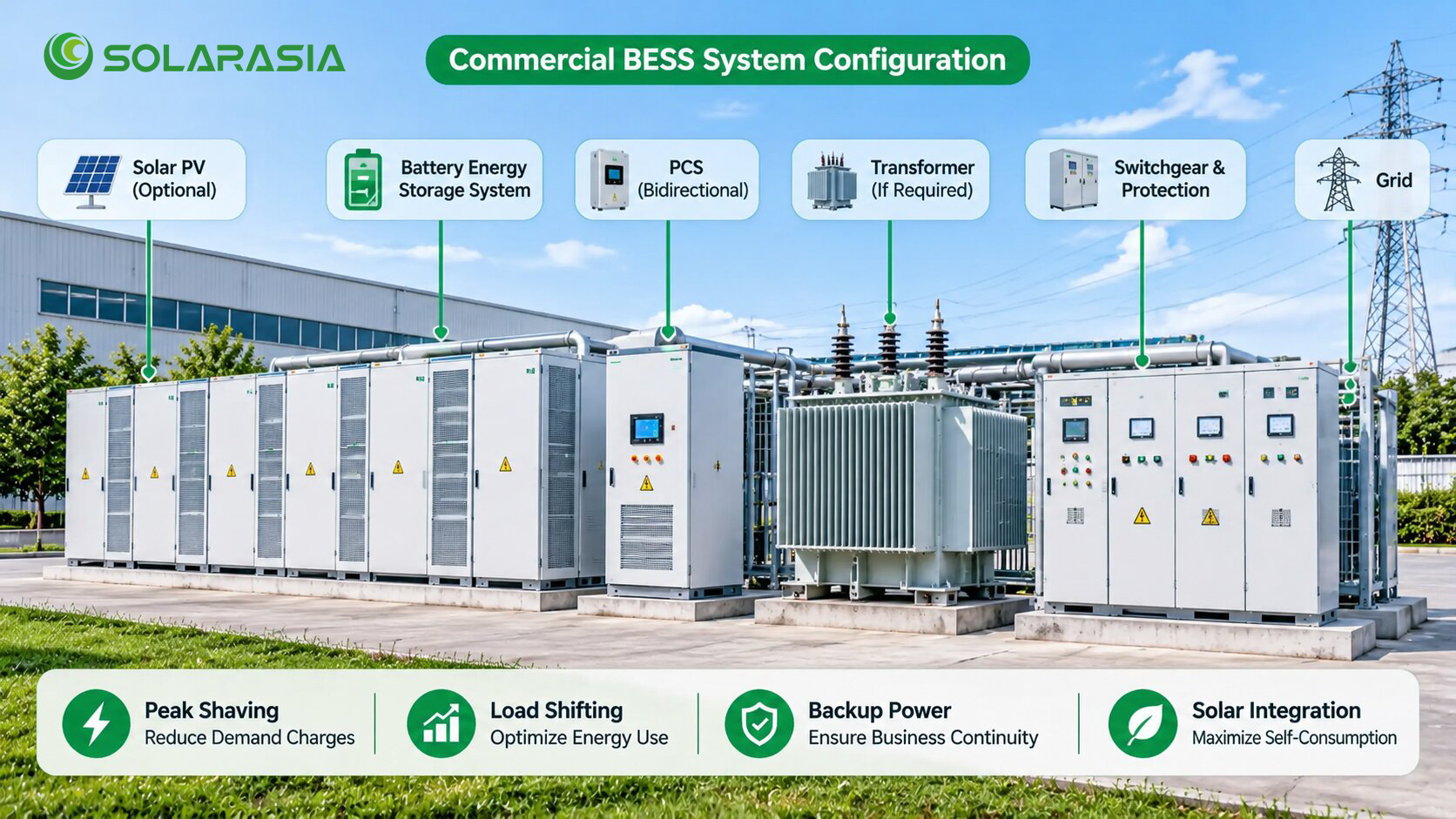
Check the factory's existing transformer capacity, grid voltage, switchgear, circuit breakers, and available electrical connection capacity.
The BESS charging and discharging strategy should be coordinated with the site's electrical limitations.
An AC-coupled BESS connects to the AC electrical system, making it a potential option for factories with existing solar PV installations.
A DC-coupled system connects through a DC architecture and may be suitable for specific new-build solar-plus-storage designs.
The preferred configuration depends on the existing equipment, inverter compatibility, project design, and operational requirements.
An energy management system can coordinate battery charging, discharging, solar generation, grid electricity consumption, and factory loads.
For factories with multiple operating schedules or complex electricity tariffs, EMS functionality is an important part of the overall BESS design.
Related Articles:BESS grid connection requirements.
Battery capacity changes over time as a result of cycling, temperature, operating conditions, and aging.
When sizing a commercial BESS, project designers should consider:
Expected battery service life
Annual operating cycles
Depth of discharge
Operating temperature
Required end-of-life capacity
Future factory load growth
For example, if a project requires a certain amount of usable energy at the end of the battery's planned service life, the initial installation may need additional capacity.
The appropriate allowance should be calculated using the manufacturer's warranted capacity-retention data and the expected operating profile.
Future expansion should also be considered during the initial electrical and system design.
This may involve reserving installation space, planning electrical connections, and confirming whether the selected BESS platform supports additional battery capacity.
Several mistakes can lead to poor system performance or unnecessary investment.
Mistake 1: Selecting Battery Capacity Based Only on Monthly Electricity Consumption
Monthly kWh consumption does not reveal the factory's peak demand, load fluctuations, or required backup power.
Use interval load data to support system sizing.
Mistake 2: Confusing kW with kWh
A battery may have sufficient energy capacity but insufficient power output to support the required loads.
Both specifications must be evaluated independently.
Mistake 3: Ignoring Actual Usable Battery Capacity
Rated battery capacity and usable energy are not always the same.
Check the usable SOC range, discharge limits, efficiency, and warranty conditions.
Mistake 4: Overlooking Motor Starting Loads
Industrial motors, compressors, and pumps may require significant starting power.
The PCS overload capability and starting strategy must be evaluated.
Mistake 5: Assuming Every Grid-Connected BESS Provides Backup Power
Backup operation requires appropriate system architecture, islanding capability, protection, and control functions.
Confirm these capabilities before purchasing.
Mistake 6: Ignoring Future Production Expansion
If a factory expects to increase production capacity, its future electricity demand should be included in the project planning process.
Related Articles:commercial BESS supplier.
To receive a suitable commercial battery storage proposal, factory owners should provide as much project information as possible.
The following checklist can help suppliers evaluate the project more accurately.
| Project Information | Recommended Details |
|---|---|
| Application | Peak shaving, backup power, solar self-consumption, load shifting |
| Factory Location | Country and project location |
| Maximum Demand | Peak electricity demand in kW |
| Daily Consumption | Average daily electricity consumption in kWh |
| Load Profile | 15-minute or 30-minute interval data, if available |
| Operating Hours | Daily production schedule |
| Required BESS Power | Target charging and discharging power in kW |
| Required Energy | Desired battery capacity in kWh |
| Backup Requirements | Critical load and required backup duration |
| Existing Solar PV | Installed solar capacity in kW |
| Grid Information | Grid voltage, frequency, and transformer capacity |
| Installation Environment | Indoor or outdoor installation |
| Expansion Plans | Expected future electricity demand |
Providing these details allows a BESS supplier to evaluate the application and recommend a more suitable system configuration.
Choosing a commercial BESS is an important investment decision. The right solution should match the factory's electricity consumption, operating requirements, electrical infrastructure, and long-term energy management strategy.
At SolarAsia, we provide commercial and industrial battery energy storage solutions for different business applications.
Our energy storage solutions can be evaluated for:
Manufacturing facilities
Industrial parks
Commercial buildings
Solar-plus-storage projects
Peak shaving and load management
Backup power applications
We support project evaluation and customized system configurations based on required power, battery capacity, operating conditions, and application requirements.
Whether your factory requires a 100 kW battery storage system, a 215 kWh or 261 kWh energy storage configuration, or a larger customized BESS solution, our team can help assess your project requirements.
Looking for a suitable commercial BESS for your factory?
Contact SolarAsia and share your factory load profile, electricity consumption, required power, and battery storage duration.
Our team can help evaluate your requirements and provide a customized commercial battery energy storage solution.
Request a Commercial BESS Quotation Today.
Start by identifying the required discharge power and operating duration. Multiply the required power in kW by the discharge duration in hours to calculate the required usable energy in kWh. Then account for the usable battery capacity, discharge efficiency, and battery degradation requirements.
The required system size depends on the factory's peak demand, electricity consumption, load profile, operating schedule, and intended application. Some factories may need a 100 kW system, while larger facilities may require several hundred kilowatts or megawatts of power.
100 kW represents the system's rated power, while 215 kWh represents its rated energy capacity. The power rating determines how much electricity the system can deliver at a given moment, while the energy capacity determines how much energy it can store.
Backup duration depends on the usable battery energy and the connected load. For example, a system with 200 kWh of usable energy supplying a constant 100 kW load could theoretically provide approximately 2 hours of energy before accounting for additional operating constraints.
Yes. A commercial battery energy storage system can be integrated with an existing solar PV installation through an appropriate AC-coupled or DC-coupled design. Compatibility with existing inverters, electrical infrastructure, and control systems should be evaluated.
LiFePO4 batteries are widely used in commercial and industrial energy storage because of their cycle-life characteristics, thermal stability, and suitability for stationary storage applications. The complete system should also include appropriate BMS, thermal management, electrical protection, and fire safety measures.
The choice depends on the required usable energy, discharge duration, operating strategy, and project budget. A 261 kWh system provides more rated energy than a 215 kWh system at the same power rating, but the final selection should be based on actual load data and usable capacity specifications.
You should prepare your factory's location, peak demand, daily electricity consumption, load profile, required battery power, desired storage duration, existing solar PV capacity, grid voltage, and application requirements. These details help suppliers develop a more suitable system proposal.


DIRECCIÓN : Room 908-909, Building 2, No. 469 Huatuo Lane, Shushan District, Hefei City, Anhui Province


Continúe leyendo, manténgase informado, suscríbase y le invitamos a que nos cuente lo que piensa.
Links: Inverter Cables
Sunrangeenergy
gmsolarkit
Derechos de autor
2026 @ Tecnología Co., Ltd de la energía de Anhui Solarasia .Reservados todos los derechos
. Mapa del sitio
| Blog
| XML | política de privacidad
 RED SOPORTADA
