


Commercial Battery Energy Storage for Cold Storage Facilities: Applications, Benefits and System Sizing
Cold storage facilities play an essential role in the food, pharmaceutical, agricultural, and logistics industries. From refrigerated warehouses and frozen food distribution centers to temperature-controlled pharmaceutical storage, these facilities rely on continuous refrigeration to maintain product quality and protect temperature-sensitive goods.
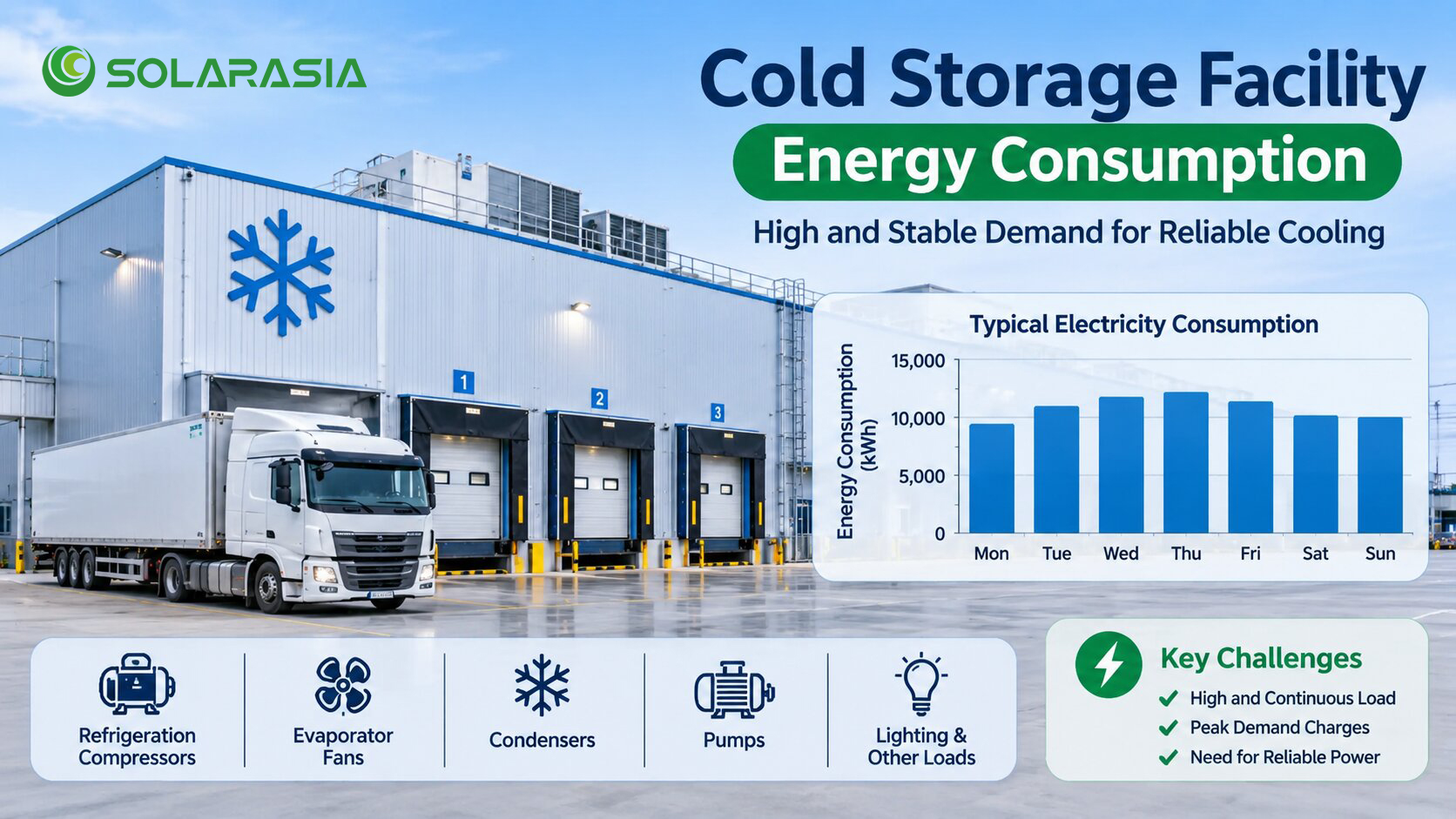
However, refrigeration systems can consume significant amounts of electricity. Compressors, evaporators, condensers, pumps, fans, and other supporting equipment may operate for extended periods, creating substantial energy demand and making electricity costs an important part of operating expenses.
As energy prices fluctuate and businesses seek more reliable energy management solutions, commercial battery energy storage systems (BESS) are becoming an option worth evaluating for cold storage facilities.
A properly designed battery energy storage system for cold storage facilities can help manage peak electricity demand, shift energy consumption, store surplus solar generation, and support selected critical loads when the grid is interrupted.
This guide explains how commercial BESS works in cold storage applications, what benefits it can provide, how to evaluate system capacity, and what facility operators should consider before selecting an energy storage solution.
Unlike many commercial buildings, cold storage facilities need to maintain specific temperature conditions over extended periods. Refrigeration equipment may operate throughout the day and night, even when warehouse activity is limited.
Several factors influence their electricity consumption.
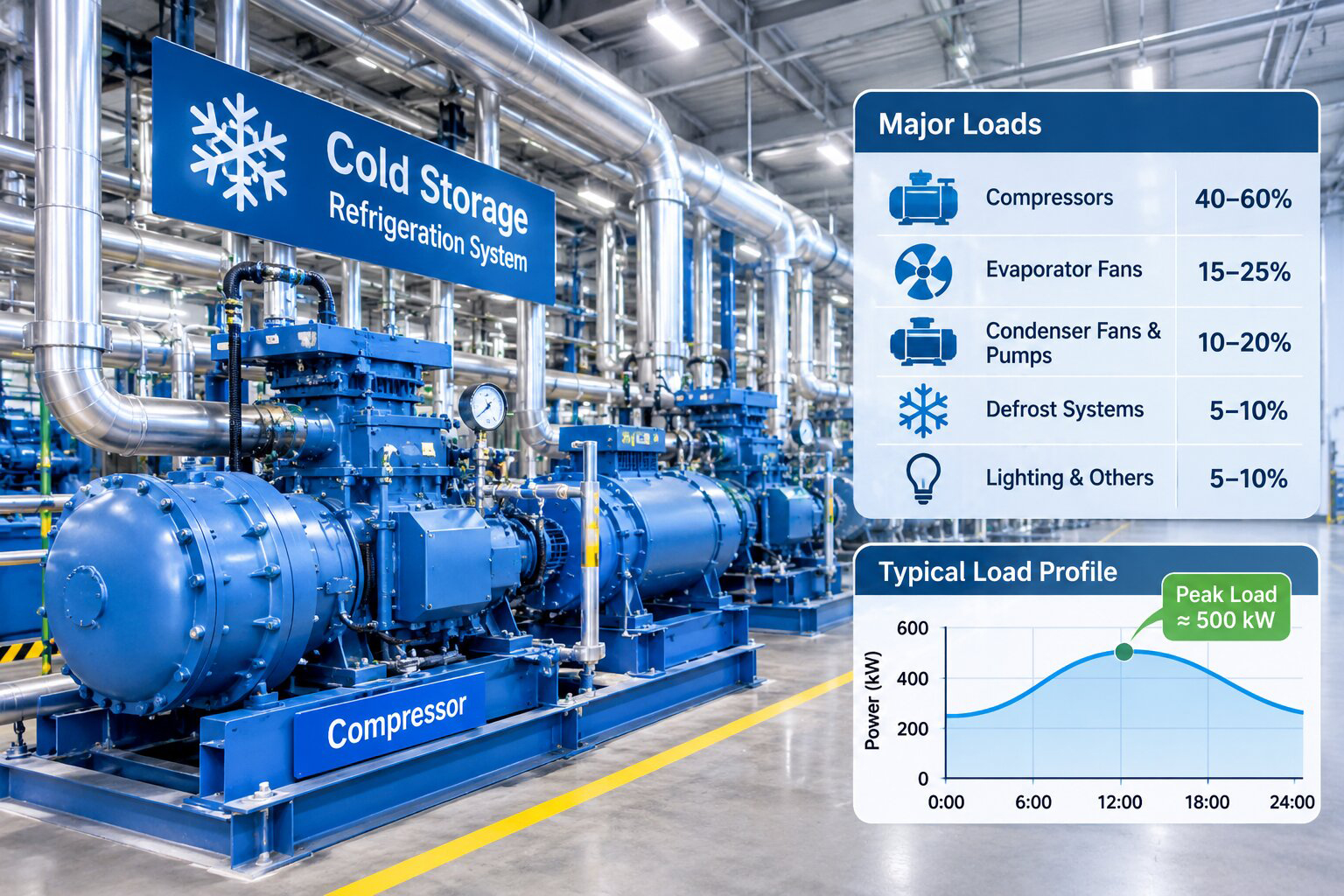
Compressors are among the major electricity-consuming components in industrial refrigeration systems.
Their power demand depends on factors such as refrigeration capacity, operating temperature, system design, cooling load, and equipment efficiency.
Large cold storage warehouses may operate multiple compressors, with their combined electricity demand changing according to refrigeration requirements.
Evaporators and condensers support the refrigeration cycle by transferring heat.
Their fans, pumps, and associated equipment also contribute to the facility's total electrical load.
Some refrigeration systems require periodic defrost cycles to remove accumulated ice from evaporator surfaces.
Depending on the equipment and defrost method, these operations may introduce additional electrical demand during certain periods.
Cold storage facilities also consume electricity through lighting, forklifts or other material handling equipment, ventilation, monitoring systems, and warehouse automation.
Although refrigeration is often a major energy consumer, the actual electricity profile varies by facility.
Understanding the contribution of each load is important before designing a battery energy storage system.
A commercial battery energy storage system stores electrical energy and releases it when needed. It typically includes battery modules or cabinets, a power conversion system (PCS), a battery management system (BMS), and an energy management system (EMS).
Depending on the project architecture, it may also include transformers, switchgear, protection equipment, thermal management, and fire safety systems.
For cold storage facilities, BESS can support several energy management strategies.
Refrigeration compressors and other equipment may operate simultaneously, creating temporary increases in electricity demand.
If the local electricity tariff includes demand charges based on peak power consumption, these demand peaks can increase operating costs.
A BESS can discharge during selected high-demand periods to reduce the electricity drawn from the grid.
For example, a cold storage facility has an original peak demand of 500 kW and aims to reduce its grid demand to 400 kW during a particular peak period.
The target peak reduction is:
500 kW − 400 kW = 100 kW
A BESS with an appropriate discharge power rating could support this target, provided its energy capacity and operating schedule are sufficient.
Actual savings depend on the tariff structure, demand measurement interval, load profile, and battery operating strategy.
Some electricity markets offer different electricity prices during peak and off-peak periods.
When the price difference is sufficient, a battery storage system can charge during lower-price periods and discharge during higher-price periods.
For cold storage facilities with predictable operating schedules, an EMS can coordinate battery operation with electricity tariffs and refrigeration demand.
The financial benefit depends on electricity price differences, battery efficiency, cycling costs, and applicable tariff rules.
Many cold storage warehouses have large roof areas that may be suitable for solar PV installations, subject to structural, shading, and electrical assessments.
However, solar generation and refrigeration demand do not always match perfectly.
During periods of high solar production, a facility may generate more electricity than it can immediately consume.
A battery energy storage system can store some of this surplus energy and discharge it later when solar production decreases.
This can increase on-site solar energy utilization and reduce reliance on grid electricity, depending on the facility's load profile and system configuration.
A power interruption can create operational risks for cold storage facilities, particularly when temperature-sensitive goods must remain within specified storage conditions.
A properly designed BESS may provide backup power to selected critical refrigeration equipment and supporting systems.
However, backup capability must be included in the system design.
The PCS, islanding equipment, protection devices, controls, and electrical architecture must support operation during a grid outage.
Not every grid-connected BESS automatically provides backup power.
Before sizing a BESS, facility operators should identify which electrical loads are essential during normal operation and which must remain available during a power interruption.
A typical cold storage facility may include the following equipment:
| Equipment | Main Function | BESS Design Consideration |
|---|---|---|
| Refrigeration Compressors | Cooling generation | Running power and starting characteristics |
| Evaporator Fans | Air circulation | Continuous or scheduled operating demand |
| Condenser Fans | Heat rejection | Operating load and control requirements |
| Refrigeration Pumps | Refrigerant or cooling circulation | Motor starting and operating power |
| Temperature Monitoring | Temperature supervision | Continuous power availability |
| Control Systems | Refrigeration and facility control | Backup power and power quality |
| Emergency Lighting | Safety and visibility | Critical backup load |
| Warehouse Systems | Material handling and monitoring | Required operating priority |
Not all equipment needs to operate at full capacity during a grid outage.
For example, a facility may prioritize refrigeration compressors, temperature monitoring, control systems, and selected pumps while temporarily reducing nonessential warehouse loads.
The critical load assessment should be conducted with the refrigeration system designer and electrical engineer.
Selecting the correct BESS capacity requires more than looking at the facility's monthly electricity bill.
The system should be designed around the actual power demand, energy consumption, operating schedule, and intended application.
Start by reviewing the facility's electricity bills and historical energy data.
Important information includes:
Monthly electricity consumption in kWh
Maximum demand in kW
Daily operating schedule
Peak and off-peak electricity prices
Existing transformer capacity
Solar PV generation, if available
Historical power interruption records
Where possible, collect 15-minute or 30-minute interval load data.
This helps identify demand peaks and understand how refrigeration loads change throughout the day.
For peak shaving, the required discharge power can be estimated using:
Required BESS Power = Original Peak Demand − Target Grid Demand
For example:
Original peak demand: 500 kW
Target grid demand: 400 kW
Required peak reduction: 100 kW
The initial discharge power target is approximately 100 kW.
For backup applications, calculate the combined power demand of the critical refrigeration equipment and other essential loads.
Also consider motor starting current, simultaneous equipment operation, power factor, and PCS overload capability.
Once the required discharge power is known, estimate how long the battery needs to operate.
A simplified formula is:
Required Usable Energy = Required Discharge Power × Required Duration
For example, a cold storage facility wants to reduce grid demand by 100 kW for 3 hours.
100 kW × 3 hours = 300 kWh
The BESS must therefore provide 300 kWh of usable AC energy during that discharge period.
The nominal battery capacity should account for the usable state-of-charge range and discharge efficiency.
Assume:
Required AC energy: 300 kWh
Usable depth of discharge: 90%
Discharge efficiency: 95%
The estimated nominal capacity is:
300 ÷ (0.90 × 0.95) = 350.9 kWh
The initial battery capacity requirement is approximately 351 kWh.
This is an illustrative calculation, not a product performance guarantee. Actual sizing should follow the manufacturer's rated and usable capacity definitions, efficiency data, operating limits, and project requirements.
For backup applications, determine how long the critical refrigeration loads need to operate during a grid interruption.
For example:
A facility has 80 kW of critical refrigeration and control loads and requires 4 hours of backup.
80 kW × 4 hours = 320 kWh
The system must deliver approximately 320 kWh of usable AC energy over the required period.
The nominal battery capacity will need to be higher after accounting for conversion losses, usable SOC limits, and other operating constraints.
The design should also consider whether the refrigeration equipment can operate with staged compressor starting or reduced-load operation.
Cold storage facilities may expand their warehouse capacity, add refrigeration equipment, or change storage temperatures as business requirements evolve.
When designing a BESS, consider:
Planned warehouse expansion
Additional refrigeration compressors
Increased storage capacity
Changes in operating schedules
Future solar PV installation
Expected electricity demand growth
A modular or expandable system may provide greater flexibility when future demand is uncertain.
Related Articles:How to size a commercial BESS for a factory.
Different cold storage facilities require different power and energy configurations.
The following examples illustrate how rated power and rated energy affect system selection.
| Example Configuration | Rated Power | Rated Energy | Theoretical Full-Power Duration |
|---|---|---|---|
| System A | 100 kW | 215 kWh | 2.15 hours |
| System B | 100 kW | 261 kWh | 2.61 hours |
| System C | 200 kW | 430 kWh | 2.15 hours |
| System D | 200 kW | 522 kWh | 2.61 hours |
These durations are calculated by dividing rated energy by rated power. They are theoretical ratios, not guaranteed usable discharge times.
Actual performance depends on usable battery energy, PCS efficiency, operating temperature, discharge limits, and the connected load.
When comparing commercial BESS configurations, facility operators should evaluate both power and energy capacity.
A system with a higher kWh rating provides more rated energy, while a higher kW rating provides greater power output.
The right combination depends on whether the main objective is peak shaving, load shifting, solar self-consumption, backup power, or a combination of applications.
Related Articles:Commericial BESS power and energy.
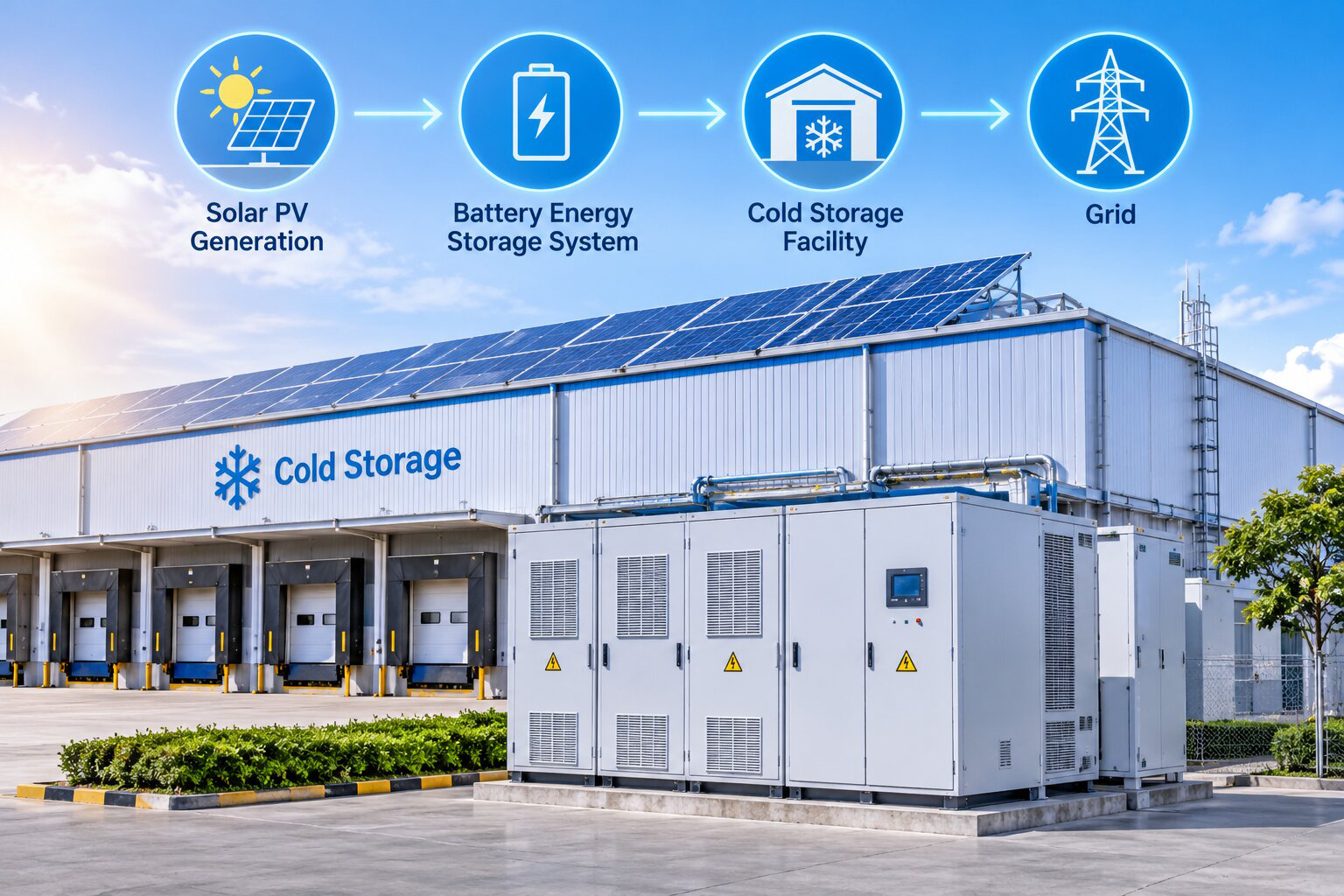
Solar-plus-storage is worth evaluating for cold storage warehouses with suitable rooftop or ground-mounted solar installations.
The combination of solar PV and battery storage can help coordinate electricity generation and refrigeration demand.
An AC-coupled system connects the battery storage system to the facility's AC electrical network.
It may be suitable for cold storage facilities that already have an operating solar PV system.
The battery system can be integrated through an appropriate PCS and energy management arrangement.
A DC-coupled architecture connects solar generation and battery storage through a DC-side configuration.
It may be suitable for certain new-build solar-plus-storage projects.
The final choice depends on inverter compatibility, electrical architecture, conversion efficiency, control requirements, and project design.
An EMS can coordinate solar generation, battery charging and discharging, refrigeration demand, and grid electricity consumption.
For example:
Solar PV supplies available daytime refrigeration loads.
Surplus solar generation charges the battery.
The battery discharges during selected peak-demand periods.
Grid electricity supplies the remaining demand when required.
This strategy should be optimized using actual load and generation data rather than assumed operating schedules.
Cold storage environments introduce specific design considerations that should be evaluated before equipment selection.
The battery system should be installed in an environment that complies with the manufacturer's operating temperature, humidity, ventilation, and enclosure requirements.
A cold storage room is not automatically a suitable location for battery cabinets.
Battery equipment may need to be installed in a dedicated indoor electrical room or an appropriately designed outdoor enclosure.
LiFePO4 (lithium iron phosphate) batteries are widely used in stationary commercial and industrial energy storage applications.
Their thermal stability and cycle-life characteristics make them a common option for BESS projects.
However, low-temperature charging limitations must be considered.
Battery charging performance depends on cell specifications and the battery management system. If the battery operates in a cold environment, suitable temperature monitoring and thermal management may be required.
The BMS monitors battery operating conditions, including voltage, current, and temperature, and manages battery protection functions.
The EMS coordinates system-level energy operation, including charging and discharging schedules.
Both systems are important for safe and efficient operation.
A commercial BESS should include appropriate electrical protection, temperature monitoring, fault detection, and fire safety measures based on the project design and applicable local requirements.
Facility operators should also evaluate equipment separation, emergency access, ventilation, and maintenance arrangements.
Related Articles:Commercial BESS safety requirements.
The financial value of a BESS depends on how effectively it addresses the facility's energy costs and operational requirements.
Several potential benefits should be evaluated.
Where demand charges apply, reducing peak grid demand may lower part of the electricity bill.
The potential benefit depends on the billing demand calculation method and how consistently the BESS can reduce relevant demand peaks.
If electricity prices vary throughout the day, battery charging and discharging may help reduce electricity procurement costs.
The analysis should include energy price differences, round-trip efficiency, battery degradation, and operating expenses.
For facilities with rooftop solar PV, storing surplus generation may increase on-site solar consumption and reduce grid electricity purchases at selected times.
A properly configured BESS may support selected refrigeration loads during grid interruptions.
Its value depends on the critical products stored, temperature requirements, interruption frequency, and alternative backup arrangements.
A complete financial evaluation should consider both energy savings and the operational value of backup capability.
Related Articles:Commericial battery storage ROI.
Several mistakes can result in an unsuitable system design.
Mistake 1: Sizing the BESS Based Only on Monthly Electricity Bills
Monthly consumption does not show short-term demand peaks or the operating characteristics of refrigeration compressors.
Use interval load data whenever possible.
Mistake 2: Ignoring Compressor Starting Requirements
Refrigeration compressors may have significant starting current requirements.
The PCS should be evaluated for transient loads and starting conditions.
Mistake 3: Treating All Refrigeration Loads as Critical Loads
Some equipment may be temporarily reduced or disconnected during an outage.
Identify the loads that must remain operational and prioritize them accordingly.
Mistake 4: Installing Battery Equipment Without Checking Temperature Conditions
Battery performance and charging limits depend on operating temperature.
Confirm the manufacturer's environmental requirements before selecting an installation location.
Mistake 5: Assuming BESS Automatically Replaces a Generator
A grid-connected battery system does not automatically provide backup power.
The project must include suitable islanding capability, controls, protection, and backup operating design.
Mistake 6: Ignoring Battery Degradation
Battery usable capacity changes over time.
Evaluate the manufacturer's capacity-retention data, warranty conditions, expected operating cycles, and required end-of-life performance.
To obtain a suitable commercial battery storage proposal, cold storage operators should prepare the following information.
| Project Information | Details to Provide |
|---|---|
| Facility Type | Cold storage warehouse, frozen food facility, pharmaceutical storage, etc. |
| Project Location | Country and installation location |
| Maximum Demand | Peak electricity demand in kW |
| Daily Consumption | Average daily energy consumption in kWh |
| Load Profile | 15-minute or 30-minute interval data |
| Refrigeration Load | Compressor, fan, pump, and supporting equipment demand |
| Main Application | Peak shaving, backup power, load shifting, or solar integration |
| Required BESS Power | Desired charging and discharging power in kW |
| Required Energy | Target battery capacity in kWh |
| Backup Duration | Required operating time for critical loads |
| Existing Solar PV | Installed solar generation capacity |
| Grid Information | Grid voltage, frequency, and transformer capacity |
| Installation Conditions | Indoor or outdoor environment |
The more accurate the project information, the easier it is for a supplier to evaluate the required BESS configuration.
Selecting a suitable battery energy storage supplier is an important step in developing a reliable cold storage energy management solution.
At SolarAsia, we provide commercial and industrial battery energy storage solutions for different business applications.
Our solutions can be evaluated for:
Refrigerated warehouses
Frozen food storage facilities
Pharmaceutical storage facilities
Food processing factories
Industrial refrigeration applications
Commercial solar-plus-storage projects
We support customized energy storage configurations based on required power, battery capacity, operating environment, and project objectives.
Whether your project requires a 100 kW battery storage system, a 215 kWh or 261 kWh energy storage configuration, or a larger customized commercial BESS, our team can help evaluate your requirements.
Planning a battery energy storage project for your cold storage facility?
Share your refrigeration load, electricity consumption, peak demand, required backup duration, and existing solar PV capacity with our team.
SolarAsia can help assess your project requirements and provide a customized commercial battery energy storage proposal.
Contact SolarAsia Today to Discuss Your Cold Storage BESS Project.
Yes. A properly designed BESS can support peak shaving, load shifting, solar energy self-consumption, and backup power for selected critical refrigeration loads. The system must be sized according to the facility's electrical requirements and intended application.
The required capacity depends on refrigeration demand, peak power, daily energy consumption, required discharge duration, and backup requirements. Actual load profile data is needed to determine a suitable configuration.
Yes, provided the system is specifically designed for backup operation. The PCS must support the required power and transient loads, while the electrical architecture must include appropriate islanding and protection functions.
LiFePO4 batteries are widely used in commercial stationary energy storage. However, battery operating temperature and low-temperature charging limitations must be considered. The selected system should follow the manufacturer's temperature and thermal management requirements.
Yes. Solar PV and BESS can be integrated through an appropriate AC-coupled or DC-coupled architecture. The system can store surplus solar generation and discharge energy when required by refrigeration loads.
BESS power, measured in kW, indicates how much power the system can deliver or absorb at a given moment. Battery capacity, measured in kWh, indicates how much energy it can store.
It may reduce electricity costs through peak shaving, load shifting, and increased solar self-consumption. The actual savings depend on electricity tariffs, load profiles, battery efficiency, and operating costs.
Important information includes peak demand, daily electricity consumption, refrigeration equipment power, interval load data, required backup duration, solar PV capacity, grid voltage, and installation conditions.


DIRECCIÓN : Room 908-909, Building 2, No. 469 Huatuo Lane, Shushan District, Hefei City, Anhui Province


Continúe leyendo, manténgase informado, suscríbase y le invitamos a que nos cuente lo que piensa.
Links: Inverter Cables
Sunrangeenergy
gmsolarkit
Derechos de autor
2026 @ Tecnología Co., Ltd de la energía de Anhui Solarasia .Reservados todos los derechos
. Mapa del sitio
| Blog
| XML | política de privacidad
 RED SOPORTADA
